Before a trip you check visas, plug types, and currency. Few people check how the internet is controlled where they are going, whether their work is legal there, or who to call if something goes wrong. For journalists, human-rights defenders, NGO staff, and researchers, those are the questions that actually affect their safety, and the hard part is that you usually don't know what to ask before you leave.
Worldwide, OONI Run v2 has produced 14.17 million measurements, and just three lists account for 72% of them. The highest-volume lists all work the same way: each one targets a single censorship or blocking phenomenon, and a continuously-running measurement backend executes it on a schedule, accumulating data over time. We surveyed every Run v2 link to measure how concentrated this is, and to draw out what the pattern offers communities that want to run their own local connectivity observation.
OONI (the Open Observatory of Network Interference) is a global censorship-measurement project. Its mobile app, OONI Probe, runs through a list of websites and reports whether each one is reachable from where you are. OONI Run v2 lets anyone compose their own list of sites to watch, generate a link, and have others run that list with one tap in OONI Probe, with every result flowing into OONI's public dataset. You can define your own measurement targets without writing code, yet few people know the feature exists or have used it, which is exactly why we wanted to see how it is actually used.
This post is based on a guest post on the Tor Blog by Unredacted, with an anoni.net community perspective added for Taiwan and the wider Sinophone region.
Unredacted is a US-based 501(c)(3) non-profit that runs a network of 300+ servers to keep people in heavily censored places connected to the open internet. Their guest post is part of the Tor Blog's spotlight series on organizations defending the free internet, and it opens with a line from a user in China: "You have helped many many people to overcome the great firewall." That kind of message is rare, because people living under censorship usually have no safe channel to send one.
This post highlights what Unredacted builds, and what it looks like from where the anoni.net community sits, in Taiwan.
For people in Iran, the outside internet barely existed for nearly three months. When connectivity started to come back a few days ago, the Tor WebTunnel bridge our community runs began taking on a wave of traffic. That was Iranians who had found a way around the censorship and reconnected to Tor, getting back onto the wider internet.
Wherever you are, you can help
If you have a VPS (a small cloud server) or a physical machine, plus a domain name, you can run a Tor WebTunnel bridge and give people cut off by censorship a way back onto the open internet. Can't run a server? Open a browser tab and run Snowflake instead, it contributes anonymous traffic just the same.
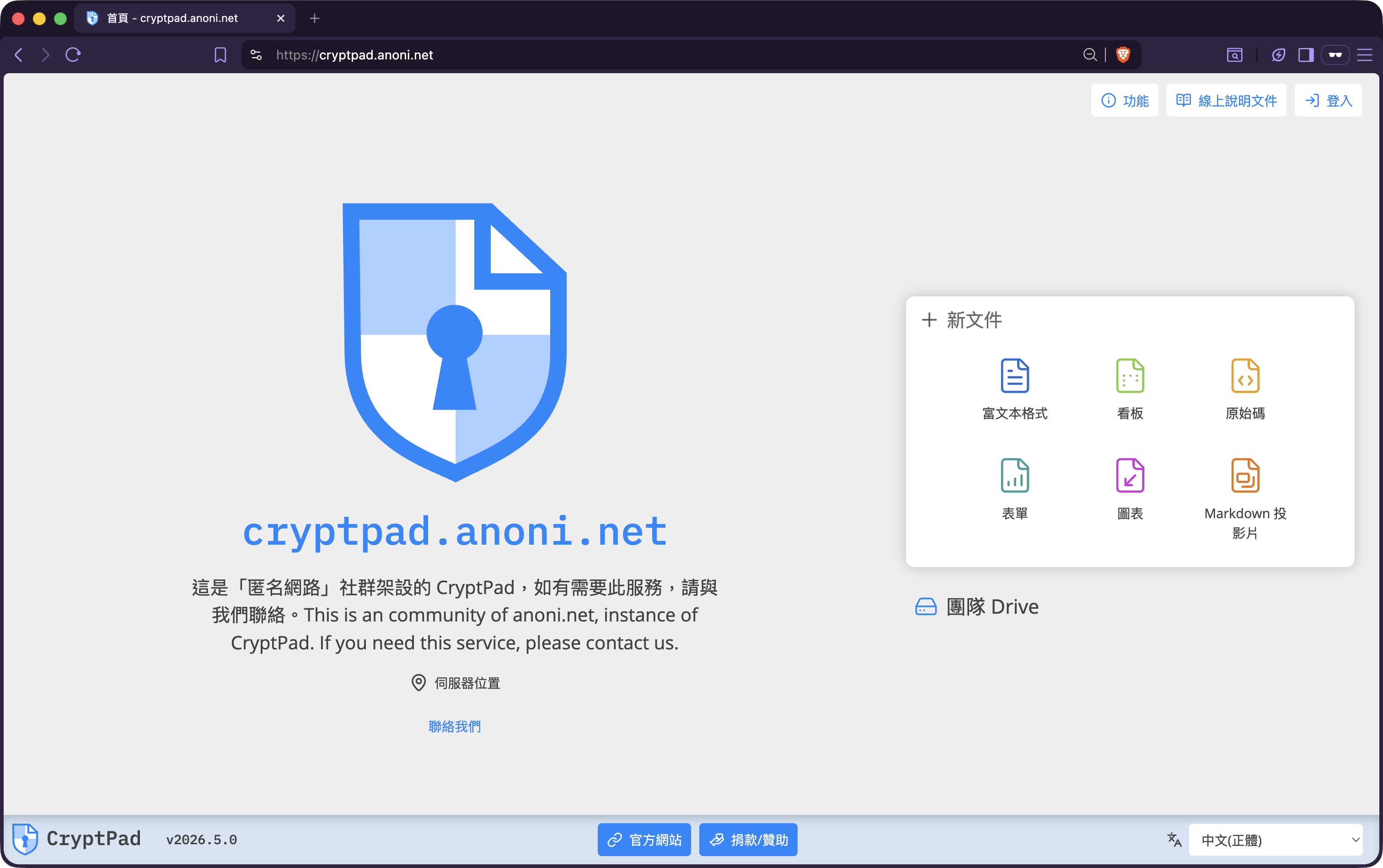
cryptpad.anoni.net Drive home after switching to 中文(正體). Every file category and app entry is localised.
For people who want a collaboration tool that does not silently keep a readable copy of their work on the server, the practical options are short. Google Docs, Notion, Microsoft 365 are excellent products, but every paragraph and every revision sits on those vendors’ servers in a form they can read. From there, algorithms, ads, training corpora, and government data requests each have their own path in.
That difference is exactly what matters when a journalist drafts a story that cannot leak, when a campaigner negotiates a strategy that cannot be wiretapped, when an NGO records distress reports from vulnerable users, or when a researcher works on a politically sensitive topic. Whether a first draft can be safely written at all often turns on that one architectural choice.
CryptPad is one of the few collaboration suites where the server genuinely cannot read what you wrote. Content is encrypted in your browser, the server only ever sees ciphertext, and yet a single interface covers most of what people normally reach for in Google Docs, Sheets, Slides, kanban boards, whiteboards, forms, and calendars.
Until recently the suite had one obvious gap for one large group of users: the UI shipped in English and Simplified Chinese only, with Traditional Chinese (zh_Hant) missing. From the first upstream PR opened at the end of 2023, through two and a half years of patient string-by-string work in Weblate, to the CryptPad 2026.5.0 “🌷 Spring release” on 2026/05/13, zh_Hant is now a built-in locale. The community-hosted cryptpad.anoni.net has been upgraded. Open cryptpad.anoni.net today and the Drive, the document editors, and the share-permission dialog are all in Traditional Chinese. Readers in Taiwan, Hong Kong, Macau, and across the Chinese-reading diaspora can use it without first learning an English menu.
A publicly listed Taipei-traded company shipped 1,708 CSA-7400 high-density network platforms to a Chinese customer between 2019 and 2020. Those appliances ended up in Kazakhstan running a national-grade internet censorship and surveillance system. The supplier was ADLINK Technologies (TWSE: 6166), the customer was Geedge Networks, and the system they ran was the flagship Tiangou Secure Gateway (TSG), an offering whose capabilities rival China's Great Firewall.
That is the central finding of MADLink: A Taiwanese Vestige in the Geedge Supply Chain, InterSecLab's April 2026 report and the first follow-up to their September 2025 The Internet Coup. The anoni.net community has completed the Mandarin (Taiwan terminology, zh-TW) translation. Unlike the previous Internet Coup release, this round also ships an editorial observation page mapping how Taiwan's media, government, and legislators have received the report — with an English summary written for international readers.
In November 2025, the first campus Tor Relay in Taiwan went live at National Taiwan Normal University's CSIE department. Over the past six months, community member NZ (Su En-Li) — the student who pushed the proposal through — worked with the community to turn that experience into a reusable template kit. The three documents are now published under CC-BY 4.0, with a long-form interview as the entry point.
The templates are ready. The next step is for more universities to take them up.
On 9 May 2017, the cross-border electronic payment service PayPal closed all domestic transaction functions in Taiwan. Two PayPal Taiwan accounts could no longer send money to each other. Cross-border transfers kept working. The streamer economy took the worst hit. Twitch Cheer, YouTube Super Chat, StreamLabs, and NightDev — tools that processed local audience tips through PayPal — went dark on the same day. Small organizations and independent media that relied on PayPal for domestic flows lost a payment rail overnight8.
The legal trigger was Article 3, Paragraph 1 of Taiwan's Electronic Payment Institution Management Act, passed in 2015. PayPal chose not to apply for a license and closed domestic functions instead9. Nearly nine years later, the U.S. online payment processor Stripe still does not allow individuals or companies in Taiwan to register. Stripe is the credit card collection layer behind Substack, many subscription SaaS products, and many open source sponsorship pages. Individual creators in Taiwan have to first register a U.S. LLC to use it10.
In Taiwan's payment conversation, these two facts have usually been filed under "compliance trade-offs" or "market size." EFF's former Activism Director Rainey Reitman, in her April 2026 book Transaction Denied12, compiles cases from 2012 onward across the U.S. and the Middle East. Stacked together, the cases reveal a cross-region, cross-issue pattern that's been running for more than a decade. Taiwan's two events belong in that record. So do parallel events from Hong Kong, mainland China, Macau, Singapore, and Malaysia, which Reitman's book — focused on U.S. and Middle Eastern material — does not yet cover.
The community-hosted onionoo-fastapi service is now public at https://onionoo.anoni.net, released as v1.0.0. It wraps the Tor Project's official Onionoo API in two interfaces: a semantic HTTP API with a full OpenAPI document, and a Model Context Protocol (MCP) server.
Connect it to Claude Desktop, Cursor, Claude Code, or any MCP-capable client and you can ask a single question like "how many running Tor relays does Taiwan have right now, what is the total bandwidth, and what are the top five ASNs?" The agent breaks the question down, picks tools, fetches the data, and returns a readable summary. You do not need to learn Onionoo's field schema before starting research.
Can you collect data from a large group of people while still protecting each individual's privacy? Differential privacy answers yes — with a mathematical proof to back it up. This article introduces the concept, traces its history from early anonymization failures to real-world deployments, and explores what it means for users and policymakers in Taiwan and the broader Chinese-speaking world.