For people in Iran, the outside internet barely existed for nearly three months. When connectivity started to come back a few days ago, the Tor WebTunnel bridge our community runs began taking on a wave of traffic. That was Iranians who had found a way around the censorship and reconnected to Tor, getting back onto the wider internet.
Wherever you are, you can help
If you have a VPS (a small cloud server) or a physical machine, plus a domain name, you can run a Tor WebTunnel bridge and give people cut off by censorship a way back onto the open internet. Can't run a server? Open a browser tab and run Snowflake instead, it contributes anonymous traffic just the same.
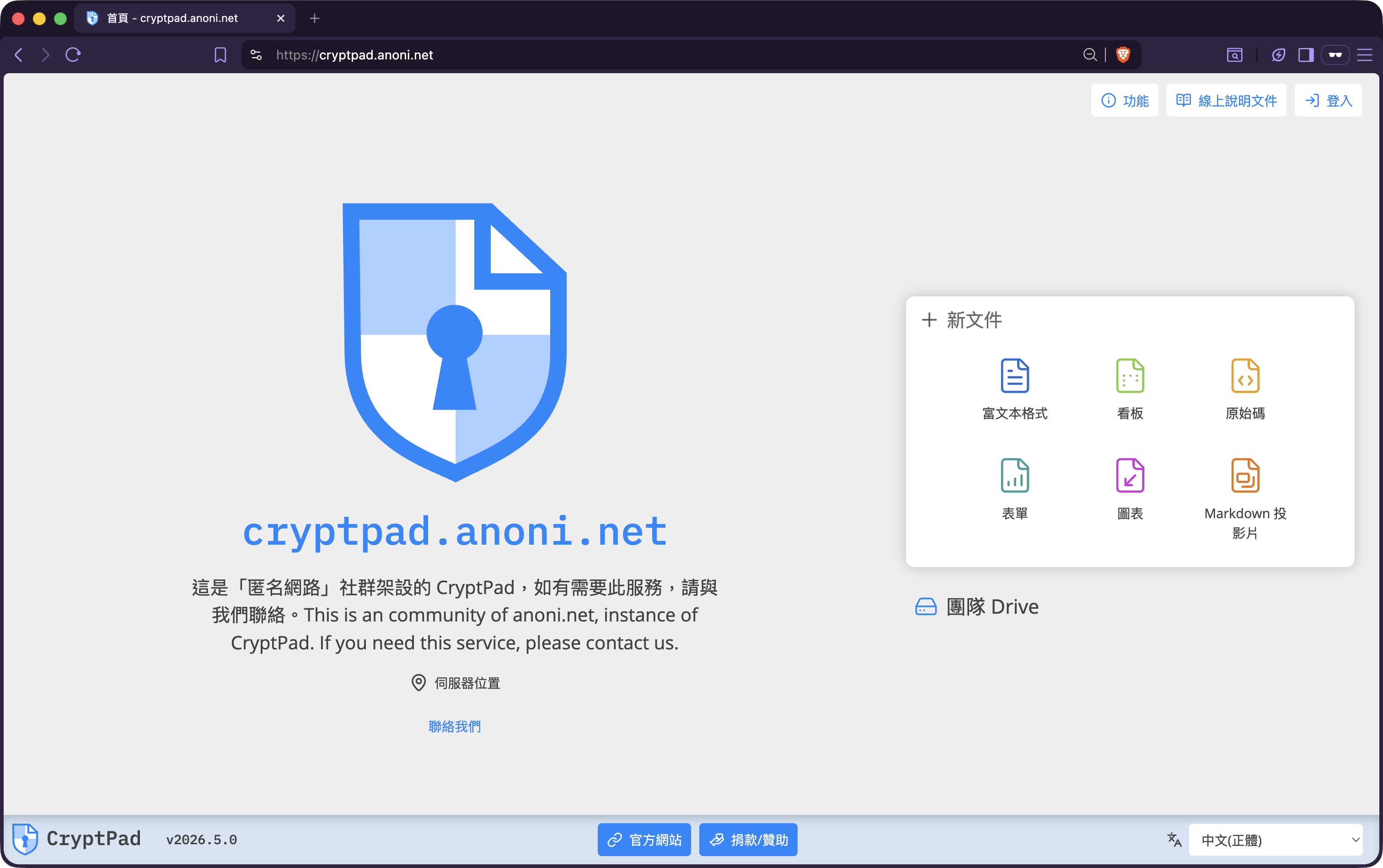
cryptpad.anoni.net Drive home after switching to 中文(正體). Every file category and app entry is localised.
For people who want a collaboration tool that does not silently keep a readable copy of their work on the server, the practical options are short. Google Docs, Notion, Microsoft 365 are excellent products, but every paragraph and every revision sits on those vendors’ servers in a form they can read. From there, algorithms, ads, training corpora, and government data requests each have their own path in.
That difference is exactly what matters when a journalist drafts a story that cannot leak, when a campaigner negotiates a strategy that cannot be wiretapped, when an NGO records distress reports from vulnerable users, or when a researcher works on a politically sensitive topic. Whether a first draft can be safely written at all often turns on that one architectural choice.
CryptPad is one of the few collaboration suites where the server genuinely cannot read what you wrote. Content is encrypted in your browser, the server only ever sees ciphertext, and yet a single interface covers most of what people normally reach for in Google Docs, Sheets, Slides, kanban boards, whiteboards, forms, and calendars.
Until recently the suite had one obvious gap for one large group of users: the UI shipped in English and Simplified Chinese only, with Traditional Chinese (zh_Hant) missing. From the first upstream PR opened at the end of 2023, through two and a half years of patient string-by-string work in Weblate, to the CryptPad 2026.5.0 “🌷 Spring release” on 2026/05/13, zh_Hant is now a built-in locale. The community-hosted cryptpad.anoni.net has been upgraded. Open cryptpad.anoni.net today and the Drive, the document editors, and the share-permission dialog are all in Traditional Chinese. Readers in Taiwan, Hong Kong, Macau, and across the Chinese-reading diaspora can use it without first learning an English menu.
In November 2025, the first campus Tor Relay in Taiwan went live at National Taiwan Normal University's CSIE department. Over the past six months, community member NZ (Su En-Li) — the student who pushed the proposal through — worked with the community to turn that experience into a reusable template kit. The three documents are now published under CC-BY 4.0, with a long-form interview as the entry point.
The templates are ready. The next step is for more universities to take them up.
The community-hosted onionoo-fastapi service is now public at https://onionoo.anoni.net, released as v1.0.0. It wraps the Tor Project's official Onionoo API in two interfaces: a semantic HTTP API with a full OpenAPI document, and a Model Context Protocol (MCP) server.
Connect it to Claude Desktop, Cursor, Claude Code, or any MCP-capable client and you can ask a single question like "how many running Tor relays does Taiwan have right now, what is the total bandwidth, and what are the top five ASNs?" The agent breaks the question down, picks tools, fetches the data, and returns a readable summary. You do not need to learn Onionoo's field schema before starting research.
On 2 April 2026, Taiwan’s Executive Yuan (the cabinet) approved the Financial Supervisory Commission’s draft Virtual Asset Service Act and sent it to the Legislative Yuan for review. If you follow crypto policy or stablecoins, this matters because Taiwan is moving from an anti–money laundering registration regime toward a licensing regime for service providers. This post is a status briefing that gathers the April 2026 cabinet move in one place for readers who mostly skip the Mandarin policy wires. It stays at the policy level. For legal questions, talk to a qualified professional in Taiwan.
This year we are excited to partner with ETHTaipei (Taipei Ethereum Community) on program coordination. Both communities approach anonymous payments from different angles. To ensure each submission reaches the most fitting audience, we will review proposals together:
Application-oriented and introductory talks: prioritized for the Anonymity Networks Community track
Technical and protocol-level talks: may be moved to the ETHTaipei blockchain track
You do not need to decide which track to submit to — we will discuss placement with speakers during the review process. Both communities will cross-promote their schedules, so attendees can move between tracks to follow related topics across the event.
On Day 2 (Aug 9), both communities plan to co-organize a dedicated session on Anonymous Payments. Speakers and attendees interested in this topic are especially encouraged to take note. If you have a relevant proposal, feel free to mention in your submission notes that you are interested in being included in the cross-community session.
This track is for lawful use and does not support money laundering, tax evasion, or other illegal activity.
For topics involving anonymity tools, crypto assets, or coin mixing, focus on education and risk understanding, and remind audiences about legal differences across jurisdictions.
Public teaching materials and demo assets should follow COSCUP requirements and use open licenses.
COSCUP is Taiwan's annual open-source community conference, centered on open-source collaboration and free admission. This track aims to connect technology communities and civic groups, expand practical exchange and local collaboration around anonymity, privacy, and internet freedom, and make participation easier for people who prefer a lower-profile presence with less personal data exposure.
The Anonymity Networks Community is now accepting proposals for the COSCUP 2026 Anonymity Networks Community Track. This is our second year running related sessions at COSCUP. Through this open CFP, we hope to invite more people who care about or actively practice anonymity to share their work. The track runs for two days and includes talks, workshops, demos, and field experience sharing.
We're excited to share that the Tor Project invited us to contribute a guest blog post about our experience running a Tor relay on a university network in Taiwan. You can read the full article here: Setting up a Tor Relay at a university in Taiwan.
Taiwan occupies a unique position in the global internet freedom landscape. While the country enjoys relatively open access to the web, it operates under persistent geopolitical pressure and is regularly targeted by sophisticated cyber operations. In this context, privacy tools like Tor aren't fringe utilities — they're practical infrastructure for journalists, researchers, civil society organizations, and anyone who needs to communicate or organize without being observed. Building awareness and local capacity around these tools is part of what our community is working toward.
On 2026/02/09, Discord announced a global “teen-by-default” rollout and stronger age verification (English coverage: BBC, Medianama). New and existing users will default to a teen-oriented experience; to relax content filters or access age-gated spaces, users must complete verification via facial age estimation or by submitting ID. Discord frames this as a commitment to teen safety and Safer Internet Day, and will use an “age inference model” in the background to help assign age groups.
We are not dismissing Discord’s intent—youth protection and compliance are serious. But such measures also mean one thing: large platforms will need more personal data and behavioural signals to “classify” users. Whether via face scans, ID documents, or algorithmic inference, the result is handing over “who you are, how old you are, where you are” to the platform and its partners. For many people who just want to chat, game, or collaborate, that may be an acceptable trade-off; for others, it raises the question: is there another way?
Commercial chat platforms have their own rules: terms of service, product direction, what data is retained, how algorithms and policies work—mostly driven by the company and shareholders, with little say for ordinary users and little visibility into how their data is used. This isn’t about “who is worse”; it’s about who gets to decide.
The anoni.net community has chosen a different path: self-hosting a Matrix homeserver. We run tuwunel, a high-performance Matrix homeserver implemented in Rust, on im.anoni.net for community discussion and 2026 theme collaboration. Server configuration, retention policy, and channel rules are decided by operators and the community together—smaller scope, more predictable, and more transparent. Our focus is clear: internet freedom, anonymous networks, and privacy in practice, not “anyone can join and talk about anything.” This is a themed, consensus-oriented workspace.
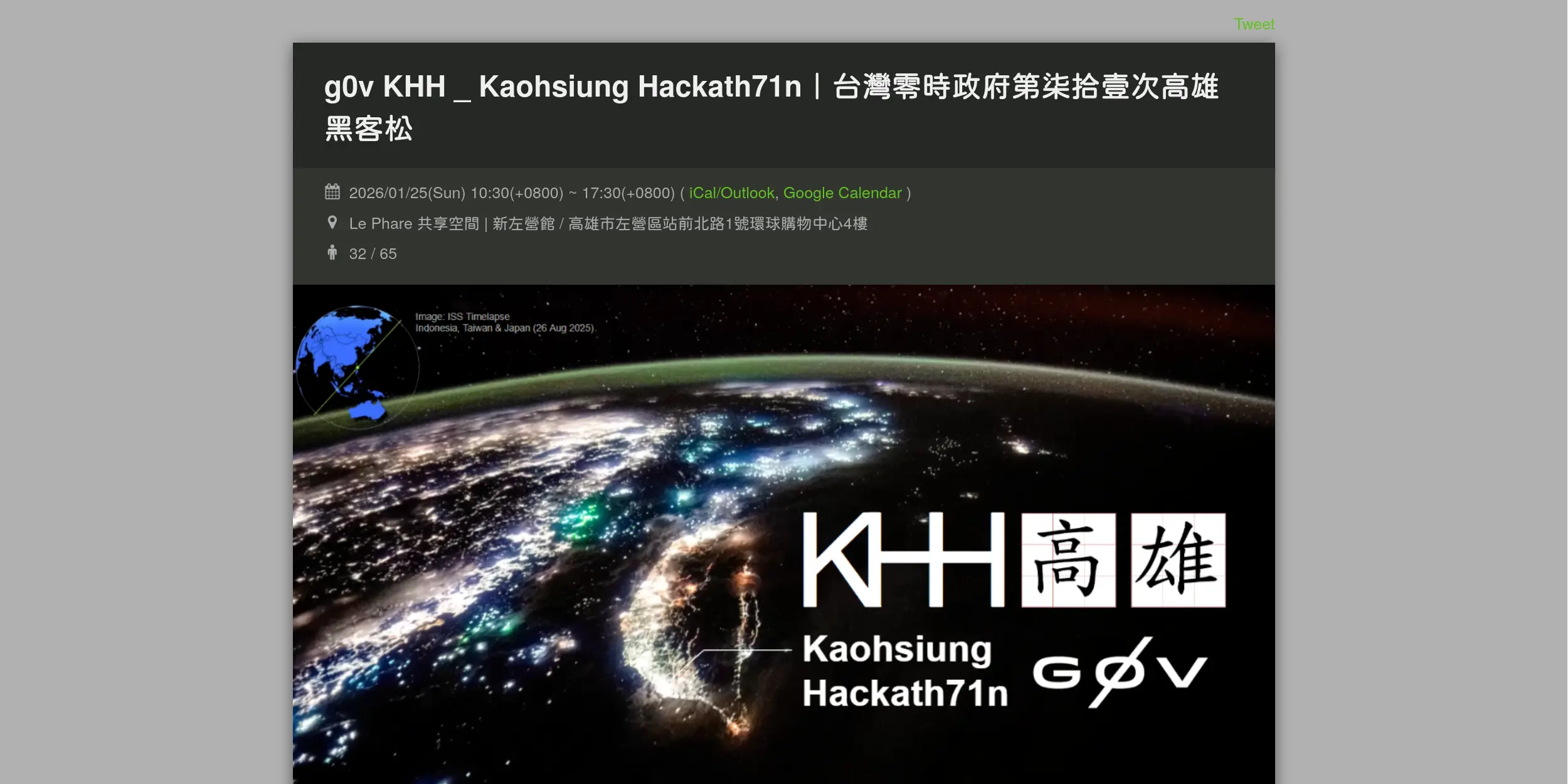
This time, we’re heading south to Kaohsiung (a.k.a. Takao) to participate in the “g0v Hackath71n – g0v the 71st Hackathon.”
If you happen to be in southern Taiwan during this period, or if you’d like to travel south to Kaohsiung together—combining a short trip with a few days of remote work while joining the event—feel free to come find us at the hackathon. We’ve registered a booth to help move forward the progress of the “Anonymous Online Community” 2026 project!
At the moment, it looks like there are still a few spots available. If you’re interested in our project and would like to contribute, you’re very welcome to join us on the day of the event—no matter your background or area of expertise.